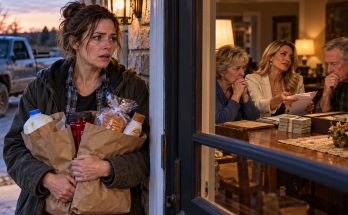
The vibration startled me.
I had been listening so carefully that I reacted as though someone inside the house had called my name again.
For a moment, I did not move.
Then I reached into my coat and took out my phone.
The grocery bags pulled against my other hand.
I shifted them awkwardly and looked at the screen.
It was a message from my accountant.
He was letting me know that the remaining paperwork connected to my land sale was ready for my records.
An ordinary professional message.
Nothing dramatic.
Nothing I needed to answer that second.
But I read it twice.
Because three days earlier, I had sold my farm for thirty-nine million dollars.
Thirty-nine million.
Even after completing the transaction, the number still seemed strange when I thought about it directly.
It represented fifteen years of work.
Fifteen years of choices.
Fifteen years of taking responsibility for the life I had decided to build.
I had spent so much of that time looking after the property that the idea of no longer owning it still felt unfamiliar.
The sale had been completed.
The papers had been signed.
The closing was finished.
The money had reached my account.
Those were the facts.
I had checked them.
I had done what needed to be done.
And afterward, I had gone home.
There had been no announcement.
No celebration for my family to attend.
No dramatic purchase.
I had not driven straight to a dealership.
I had not replaced my old truck.
I had simply gone back to my ordinary routine.
That evening, I made dinner.
I remember how normal that felt.
A transaction worth thirty-nine million dollars had been completed, and I was still standing in my own kitchen thinking about food.
I did not feel a sudden need to become a different person.
I had worked too long to believe that one amount of money could erase the habits that had helped me get there.
I still preferred keeping things simple.
I still saw no reason to buy something new just because I could.
I still had no desire to announce my finances to everyone around me.
Especially not my family.
I had planned to tell them about the sale eventually.
There was no reason to keep it secret forever.
But I had wanted the news to settle in my own mind first.
The farm had been central to my adult life.
Selling it was not something I could understand entirely through a bank balance.
I needed time.
I needed to get used to the fact that the property I had worked on for years was no longer mine.
And I wanted to consider what that meant before listening to everyone else's opinions.
I knew Ranata would have something to say.
She almost always did.
I expected my parents would have questions.
That was natural.
But I wanted the announcement to happen when I felt ready.
Not because someone else expected it.
Not because I was trying to impress them.
And certainly not because I needed to prove I was doing well.
On the porch, looking at my accountant's message, I realized how easily I could end the part of the conversation that concerned my supposed financial hardship.
I could open the door.
Put down the groceries.
Tell them the farm had sold.
Tell them the price.
Watch them understand that I was not in financial trouble.
The whole idea of me needing to borrow money would immediately look different.
At least, that was what I imagined.
For a brief second, the thought was satisfying.
I could picture my parents looking surprised.
I could picture Ranata trying to explain what she had been saying.
I could finally show them that the old truck and my plain clothes had never told the full story.
But the satisfaction disappeared almost immediately.
Because the money in my account did not explain the money my parents believed they had given me.
Those were separate things.
One was the result of my work.
The other was a mystery I had discovered by accident.
I put my thumb against the edge of the phone.
Then I looked toward the door.
My father had asked whether I had repaid previous assistance.
My sister had said I had not.
My mother had questioned whether I needed more.
And all of it had happened while I stood outside with groceries.
If I walked in and announced the sale, that news would become the center of attention.
I knew it.
Thirty-nine million dollars was the kind of number that could swallow every other part of a conversation.
People would want to know about the transaction.
They would ask what I intended to do next.
They might look at my truck and wonder why I was still driving it.
They might suddenly speak to me as though I had become somebody different.
I did not want any of that.
Not then.
I wanted an explanation for the money they thought had been sent to me.
And I wanted that explanation before they knew about the sale.
It was the first truly clear decision I made that afternoon.
I was not going to use my new financial position to silence a conversation I needed to understand.
I was not going to turn the situation into a contest between my sister's comfortable life and my own.
That would have been easy.
But easy was no longer good enough.
I looked at the groceries again.
The milk had shifted in its bag.
The coffee and creamer were still together.
Everything was exactly as it had been when I arrived.
Ordinary.
Useful.
Purchased because my mother had asked me for a favor.
I thought about that small request.
Mom had needed a few things.
She had asked me directly.
I had brought them.
There had been no reason for anyone else to become involved.
It was such a simple exchange.
And that simplicity made the larger situation harder to understand.
If my parents genuinely believed I needed money, why had they not asked me?
They knew how to reach me.
They knew I visited.
They knew I was capable of having a conversation.
They could have asked whether I was struggling.
They could have asked whether I had borrowed anything from Ranata.
They could have asked whether I needed help with my farm.
But I had no memory of any such conversation.
Instead, they apparently relied on my sister to explain my situation.
And she had given them an account that was false.
I tried to imagine a reason for it.
Perhaps Ranata had begun by exaggerating my difficulties.
Perhaps my parents had offered to help and she had presented herself as the person who could arrange it.
Perhaps the situation had developed gradually.
I could not know.
Those thoughts were possibilities, not facts.
I forced myself to remember that.
I did not know how much money had been given.
I did not know when the payments began.
I did not know what Ranata had said to obtain them.
But I knew one thing with absolute certainty.
None of that money had reached me.
I had never been told it existed.
And I had never promised anyone repayment.
That was enough to make me question what had been happening.
I thought about how differently I might have interpreted the conversation if my farm had not just sold.
If I were still working there and handling the same responsibilities, I would have been equally innocent of the supposed debt.
The truth would have been the same.
I would still have had every right to ask why money had been collected in my name.
That realization helped me.
Because for a moment, I had been tempted to treat the sale as the answer to everything.
It was not.
The size of my account did not determine whether my sister's statements were true.
The old truck had never made me dishonest.
The sale did not suddenly make me trustworthy.
I was the same person who had driven up the driveway.
The difference was that I now knew my family had been discussing a financial arrangement I had never agreed to.
That was the issue.
I slipped my phone back into my coat.
I felt the bag handles tightening around my fingers again.
They had left marks.
I loosened my grip and looked toward the front door.
I could still hear voices inside, but I was no longer trying to catch every word.
My mind was occupied with the questions I would eventually need answered.
How much?
How often?
For what purpose?
And most importantly, where had the money gone?
I knew I could not answer those questions from the porch.
I also knew I was not ready to walk in.
I did not want Ranata to see my expression and immediately understand that I had overheard her.
I did not want my father to begin asking me about a debt while I was still trying to understand its existence.
I did not want Mom to look at the groceries and become distracted by the fact that I had arrived.
I needed space to think.
That was not something I often admitted.
I was used to solving problems as soon as they appeared.
On the farm, delaying a necessary decision could create more work.
Sometimes you simply had to start.
But this was not a broken piece of equipment.
It was my family.
And the problem involved trust.
I could not repair it with the right tool or a few hours of effort.
I needed information.
I needed to know what had actually happened.
I looked down at the bags one last time.
Then I lowered them onto the porch beside my boots.
The handles slipped from my fingers.
For a moment, I stood there looking at them.
I had come to deliver groceries.
Leaving them at the door would have been the easiest thing to do.
Mom would find them.
She would probably wonder why I had not knocked.
I could drive away and say I had been in a hurry.
But even that felt wrong.
I did not want my visit to become another unexplained thing my family could discuss without me.
I bent down.
Picked up both bags.
And turned away from the entrance.
The walk back to my truck felt longer than the walk toward the house.
I was aware of every step.
The weight of the milk.
The sound of my boots.
The familiar shape of the pickup waiting in the driveway.
I kept expecting someone to open the front door.
Nobody did.
I reached the passenger side and placed the groceries back on the seat.
The bag containing the milk settled against the other one.
I checked that nothing would tip over.
It was such an ordinary little movement.
Even now, I remember doing it carefully.
I shut the passenger door.
Then I walked around the truck and got behind the steering wheel.
For a moment, I did not start the engine.
I just sat there.
The driveway was familiar.
The house was familiar.
Ranata's SUV was still parked nearby.
Nothing outside suggested that anything important had happened.
But I knew I could no longer look at the situation in the same way.
I had always thought the problem was that my family underestimated me.
They saw my old truck and assumed I could not afford better.
They saw my work clothes and assumed I had not made much progress.
They heard about the hard parts of farming and imagined that the whole business was one long struggle.
I had found those assumptions irritating.
Sometimes insulting.
But I had accepted them because I thought they did not affect my life.
Now I had evidence that something more serious might be happening.
My parents believed they were supporting me financially.
They believed I had failed to repay them.
And my sister was apparently the person receiving their questions and making requests on my behalf.
That could not be dismissed as an unkind comment.
It was not an opinion about my farm.
It was a claim about money.
I thought of my accountant's message.
The final documents were ready.
The sale was complete.
Thirty-nine million dollars had changed hands three days earlier.
I had spent years working toward a future in which I would have choices that did not depend on the next repair or the next expense.
Now that future had arrived.
And I was sitting in an old pickup outside my parents' house, wondering whether someone had been using their concern for me to obtain money.
The contrast was almost absurd.
For one brief moment, I felt the urge to laugh.
Not because I found anything amusing.
I simply could not believe how far apart the two realities were.
The truth of my finances.
And the story my sister was telling.
Both involved my name.
Both involved my family.
Yet they had almost nothing in common.
I started the engine.
The truck responded with its familiar sound.
I had driven it through years when I could have used an easier day.
I knew every imperfection.
I knew how dependable it had been when I needed it.
It had never bothered me that someone else might see it as a sign of failure.
Now I wondered whether I had been too willing to let people believe what they wanted.
For fifteen years, I had kept my successes mostly to myself.
I had handled my difficulties privately.
I had not wanted my life measured against Ranata's.
I still did not.
But I was beginning to understand that silence could leave space for someone else's version of events.
And once that version became familiar, it could be difficult to challenge.
I backed out of the driveway.
I did not ring the bell.
I did not call Mom to say I had been there.
I did not confront Ranata.
There would be time for questions.
But I wanted those questions to be about the truth, not about who had more money.
I drove away with the groceries beside me.
The creamer Mom liked was still in the bag.
The bread was still there.
So was the coffee.
The visit had begun with a simple favor.
It ended with me carrying everything back to my truck because I could not walk through my parents' front door and pretend I had heard nothing.
I was angry.
I was hurt.
And I was more confused than I wanted to admit.
My sister had apparently been describing me as someone who could not manage without help.
My parents seemed to have accepted that description.
They had apparently provided money they believed was intended for me.
And I had never received it.
I thought of the question my father had asked.
Whether I had repaid any of what they had given.
I had no answer I could offer him without first asking one of my own.
What had they given?
And to whom?
As I drove away, I understood that the sale of my farm would eventually become important to my family.
Thirty-nine million dollars was not a number people could easily ignore.
But I was not thinking about what they would say when they discovered it.
I was thinking about what had happened before they knew.
I had believed my family saw me as the daughter who was less successful.
Now I knew they saw me as a daughter who had apparently needed money for years.
I had spent so much time working for my own independence that I had never imagined someone might be claiming I did not have any.
The account I had built through fifteen years of work was real.
The money my parents believed they had given me was real to them.
But the help they thought I had received had never reached me.
I drove home knowing I needed to find out where it had gone.
And for the first time, I questioned not only what my family believed about me, but who had been benefiting from those beliefs.
Source: thknews11.store
Click here to continue reading: PART 5: I Returned Home With My Mother’s Groceries and Tried to Decide How to Confront a Family That Believed I Owed Them Money
I Arrived at My Parents’ House Carrying Groceries, Never Imagining That a Conversation Behind Their Front Door Would Change Everything I Believed
Part 4 of 15