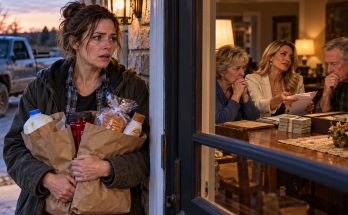
I had imagined telling my family about the sale many times.
Before Saturday, those imagined conversations had been simple.
I would mention that the farm had sold.
Mom would be surprised.
Dad would ask questions.
Ranata would have an opinion.
I would explain what I wanted to explain.
Then the conversation would move on.
That was how I had expected it to happen.
But after confronting Ranata, nothing about my family felt simple.
The money my parents had provided was no longer an innocent misunderstanding.
My sister had acknowledged she had not passed it to me.
She had allowed them to believe I needed assistance.
She had told them I was failing to repay money I never received.
Those things had changed how I understood our relationship.
I had spent years thinking Ranata simply underestimated me.
Now I knew she had benefited from the way our parents saw my life.
The records still needed careful examination.
There were payments to reconcile.
There were questions about how the money had been used.
Those practical matters belonged to my parents and Ranata.
I had never received the money.
I had never agreed to repay it.
And I was not going to accept responsibility for it.
That decision was settled.
What remained was the truth about my own finances.
I sat at my kitchen table with the paperwork from the sale.
The transaction had been completed days before that Saturday visit.
Thirty-nine million dollars.
The figure still seemed enormous when I looked at it.
I had spent fifteen years working toward a future in which my choices would not be controlled by immediate financial pressures.
The farm had given me that future.
Not easily.
Not quickly.
And not without sacrifices.
But it had.
I looked at the old truck through the window.
I had kept it because it worked.
I had worn practical clothes because my work required them.
I had delayed purchases because I believed money should be used carefully.
Those choices had never meant I was failing.
They had been part of how I managed my life.
For years, my family had interpreted them differently.
I could accept that.
People misunderstand appearances all the time.
What I could not accept was someone turning those misunderstandings into false financial claims.
That was what Ranata had done.
And now everyone knew it.
I thought about whether I should continue keeping the sale private.
Part of me wanted to.
The transaction was my business.
I did not owe anyone an announcement.
And after everything that had happened, I was not eager to invite more opinions about my money.
But another part of me understood that the sale marked a major change in my life.
My parents were still my parents.
Despite their mistakes, they had shown they were willing to listen.
They had examined the records.
They had acknowledged that they should have asked me directly.
And they had accepted that the supposed debt was not mine.
I did not have to hide the sale simply because Ranata had lied.
I could choose when and how to share it.
That was part of being independent.
I decided to tell Mom and Dad privately.
I did not invite Ranata.
There was no reason to make the announcement another confrontation.
My sister's conduct was already being addressed.
I wanted the sale to be discussed separately.
When I arrived, Dad opened the door.
He looked tired.
Mom was in the kitchen.
I noticed the familiar smell of coffee.
For a moment, I thought about the unopened package still sitting at my house.
I had never managed to deliver those groceries.
It seemed like such a small unfinished task compared with everything else.
Mom asked whether I wanted coffee.
I said yes.
We sat together.
There was no stack of records on the table this time.
I was grateful for that.
I did not want to spend the entire visit discussing what Ranata had done.
I wanted to tell my parents something about my own life.
Something they had not known.
I looked at Dad.
"There's something else I need to tell you."
He nodded.
Mom watched me carefully.
I took a breath.
"The farm sold."
Dad looked surprised.
He asked when.
"Three days before I came over with the groceries."
Mom blinked.
"You sold the whole farm?"
"Yes."
Dad leaned forward.
"Are you comfortable telling us what you got for it?"
I had expected the question.
I looked from him to Mom.
"Thirty-nine million dollars."
For a moment, nobody spoke.
Mom set down her cup.
Dad stared at me.
I could see them trying to understand the number.
It was not the kind of amount they had associated with my life.
Not with the old pickup.
Not with the work clothes.
Not with the years of repairs and careful spending.
Mom repeated the figure quietly.
I nodded.
"Thirty-nine million."
Dad looked toward the window.
Then back at me.
"You've been doing that well?"
I thought about how to answer.
I could have made a speech.
I could have reminded them of every comment about the farm.
I could have described how often Ranata made my choices sound like failure.
I could have used the moment to prove them wrong.
But I did not want to.
I had spent too long feeling misunderstood.
I did not want my success to become another argument.
"I worked hard for a long time."
That was all I said.
Dad nodded slowly.
Mom looked emotional.
She asked why I had not told them earlier.
I considered the question.
Then I answered honestly.
"I wanted time to understand it myself."
She nodded.
I continued.
"And after Saturday, I didn't want the sale to distract from the money you thought you'd given me."
Dad looked down.
He understood.
At least, I believed he did.
I had not wanted them to accept my word only because I had become wealthy.
I wanted them to understand that I had never borrowed from them.
That had been true before the sale.
It was true afterward.
The amount in my account did not change it.
I explained that.
Dad listened.
Mom did too.
For once, neither interrupted.
I told them I had not hidden my finances to embarrass them.
I had simply preferred handling my own affairs.
I had not wanted every decision questioned.
I had not wanted my life compared with Ranata's.
And I had not felt obliged to prove I was successful.
Mom looked at me.
"We thought you were having such a hard time."
I nodded.
"Some years were hard."
That was true.
"There were repairs. There were expenses. There were days I wondered whether I wanted to keep going."
I looked at Dad.
"But I handled them."
He nodded.
I continued.
"Driving an old truck didn't mean I couldn't afford another one."
Mom lowered her eyes.
"And working long hours didn't mean I needed someone to support me."
There was a silence.
Not an angry silence.
A thoughtful one.
I wanted them to understand the difference between a difficult life and an unsuccessful one.
I had chosen work that required effort.
That did not mean I had failed.
I had chosen to spend carefully.
That did not mean I had no money.
I had chosen to keep my finances private.
That did not mean my sister had the right to invent them.
Dad finally spoke.
"We should have asked you."
I looked at him.
"Yes."
He nodded.
There was no argument this time.
No attempt to explain why Ranata seemed more reliable.
No suggestion that my pride had caused everything.
Just an acknowledgment.
It did not erase what had happened.
But it mattered.
Mom reached across the table.
She placed her hand near mine.
"I wish we'd known."
I thought about that.
There were things I wished they had known too.
Not the sale price.
Not every financial detail.
I wished they had known I was capable.
I wished they had trusted me.
I wished they had asked before accepting someone else's version of my life.
But I did not say all of that again.
We had already discussed it.
I wanted to leave room for something different.
A more honest relationship.
One in which they could ask questions and I could answer without feeling judged.
One in which my sister's confidence did not automatically make her right.
One in which silence was not treated as evidence of guilt.
That was what I hoped for.
I did not know whether we could achieve it.
Trust was not something a single conversation could repair.
But the first step had been taken.
I had told the truth.
My parents had listened.
And the false debt no longer belonged to me.
We spoke for a while about the sale.
Dad asked practical questions.
I answered what I was comfortable sharing.
Mom seemed relieved that I had done well.
I could see surprise in their faces.
Perhaps pride too.
But I reminded myself that I did not need their approval to make the sale meaningful.
The work had already happened.
The transaction was complete.
The money was mine.
I had earned the right to decide what came next.
When the conversation turned toward Ranata, I kept my answer simple.
"I need some distance from her."
Mom looked sad.
I understood.
No parent wants to hear that one child no longer trusts another.
But I could not pretend everything was fine.
Ranata had used my name.
She had accepted financial help meant for me.
She had allowed our parents to believe I owed repayment.
And she had not been honest about it until we questioned her.
Those were not small mistakes.
I did not know whether she would eventually accept full responsibility.
I did not know whether she would repay the money.
I did not know whether my parents would forgive her.
Those decisions were not entirely mine.
But I could decide what role she would have in my life.
I would not allow her to speak about my finances as though she understood them.
I would not let her request money on my behalf.
And I would not continue pretending her remarks were harmless.
I told my parents that.
Dad nodded.
Mom listened quietly.
I did not ask them to choose between us.
I did not want that.
I simply asked them to respect the boundary.
They agreed.
When I left, I felt something I had not felt since Saturday.
Relief.
Not complete.
Not uncomplicated.
But real.
The sale was no longer a secret from my parents.
The false debt had been challenged.
Ranata's role had been exposed.
And I had spoken for myself.
I drove home in the same old pickup.
The engine made its familiar sounds.
I noticed them without embarrassment.
For fifteen years, that truck had been part of my working life.
It had never been a measure of my worth.
It still was not.
When I arrived home, I carried the remaining groceries into the kitchen.
I looked at the coffee package.
The bread was no longer as fresh as it had been.
The creamer was still in the refrigerator.
I decided not to keep treating them as reminders of betrayal.
They were groceries.
Ordinary things.
Bought for my mother.
I could buy fresh ones another day.
That thought felt surprisingly comforting.
Not everything had to remain connected to Saturday.
Some things could become ordinary again.
I put the papers from the farm sale away.
They belonged to my future.
The notes about the supposed family debt went into a separate place.
They belonged to something my parents still needed to resolve with Ranata.
I did not want to confuse those matters anymore.
My money was mine.
Their money was theirs.
And the money they believed they had given me had never reached me.
That truth was finally understood.
I sat at the kitchen table.
For a long time, I did nothing.
There was no farm emergency waiting.
No argument I needed to continue.
No announcement left to make.
I could simply sit.
That was unfamiliar.
For fifteen years, I had measured my days by how much work remained.
Now I had time to consider what kind of life I wanted.
I did not have an answer yet.
I knew I wanted some peace.
I knew I wanted to make decisions without feeling that I needed to prove myself.
And I knew I wanted relationships built on direct conversations rather than assumptions.
Those were simple wishes.
But they mattered more to me than I had understood.
I thought about the afternoon I stood outside my parents' house.
The grocery bags.
The closed blinds.
Ranata's voice.
Dad's question.
The message from my accountant.
I had believed the most important surprise was the enormous difference between what my family thought I had and what I actually possessed.
But that was not the real lesson.
The real problem was that someone had been telling a false story about me.
And the people closest to me had accepted it without asking.
The sale had given me financial freedom.
The conversation had taught me something else.
I needed to protect my right to speak for myself.
I could be private without being silent when it mattered.
I could be generous without allowing someone to use my name.
I could love my family without accepting false accusations.
And I could forgive mistakes without pretending they had caused no harm.
I did not know what the future would look like with Ranata.
Perhaps she would eventually acknowledge everything fully.
Perhaps she would repair some of the damage.
Perhaps our relationship would remain distant.
I could not decide those things for her.
But I could decide what I would accept.
I would accept honesty.
I would accept direct questions.
I would accept responsibility.
I would not accept another arrangement made in my name without my knowledge.
I looked toward the window.
My old pickup was parked outside.
It was still the same truck.
I was still Fay.
Thirty-seven years old.
A woman who had worked fifteen years to build an independent life.
A woman who had sold her farm for thirty-nine million dollars.
And a woman who had learned that being underestimated was not the worst thing her family could do.
The worst thing was being excluded from decisions about her own life.
I could not change what happened before Saturday.
But I could make certain it did not continue.
That was enough for me.
For the first time in days, I felt ready to think about something other than the money.
I had a future to plan.
And this time, I intended to make those decisions myself.
Source: thknews11.store
The End
Read more original stories on readstoryus.
I Arrived at My Parents’ House Carrying Groceries, Never Imagining That a Conversation Behind Their Front Door Would Change Everything I Believed
Part 15 of 15