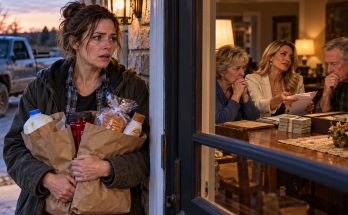
The answer came after a pause.
Ranata told our father that I had not paid back the earlier money.
She added that I was still unable to keep up.
I remember the exact feeling of standing there.
It was as though the air had changed.
Nothing around me moved.
The house was still the same.
The groceries were still in my hands.
But I had reached the point where I could no longer explain the conversation as an innocent misunderstanding.
My sister was not simply worried about me.
She was reporting on a debt.
My supposed debt.
And she was describing my failure to repay it as an ongoing problem.
I looked toward the driveway.
My pickup was parked beside Dad's sedan.
Ranata's SUV sat nearby.
Three vehicles.
Three different impressions of the people who owned them.
I suddenly wondered how often those impressions had mattered more to my family than anything I had actually said.
Mine was the oldest.
That part was obvious.
It had been useful to me for years.
I knew its noises.
I knew what needed attention.
I knew which imperfections were worth fixing immediately and which could wait.
To somebody else, it might have looked like proof that I could not afford anything better.
To me, it was simply a vehicle I had not needed to replace.
The same was true of my work clothes.
They were practical.
They suited my days.
They were not evidence of a financial emergency.
Yet I had heard enough comments over the years to know what Ranata thought they meant.
I had always assumed her opinion was just that.
An opinion.
Now I was wondering whether she had turned those impressions into something my parents acted upon.
The thought made me feel sick.
I knew what it was like to have an expensive problem arise unexpectedly.
Anyone who owned property knew that feeling.
A repair could interrupt the best plan.
A bill could arrive before it was convenient.
There were decisions you made because they were sensible, not because they were enjoyable.
I had never pretended my life was effortless.
But I had handled it.
That was the important part.
When money was tight, I adjusted.
When something could wait, I waited.
When equipment needed work, I found a way to deal with it.
There had been no secret arrangement with my parents.
No emergency payments through Ranata.
No family fund supporting the farm.
I had built my life around the understanding that I was responsible for it.
And I had never asked to be treated differently.
I thought about what my father must believe.
He had apparently given money he expected to be returned.
He believed I had not returned it.
He believed the situation was continuing.
What did that make me in his eyes?
Careless?
Ungrateful?
Too proud to ask directly, but willing to accept help through my sister?
I hated imagining him thinking those things.
Partly because they were untrue.
Partly because I knew how easily they could become permanent judgments.
A person who believes you are irresponsible begins to interpret everything through that belief.
A delayed repair becomes proof.
An old truck becomes proof.
A quiet answer about work becomes proof.
Even refusing help can look like pride instead of independence.
I realized I had been living with the beginnings of that story for years.
I just had not known how far it had gone.
There was a time when I thought silence showed confidence.
If someone made an unfair remark, I did not need to answer it.
If someone underestimated my farm, I did not need to recite numbers.
If Ranata made another comparison, I could let it pass.
I still believed there was dignity in not explaining every decision.
But dignity was not the same as allowing someone to tell lies.
And I was beginning to understand the difference.
I had not heard every conversation my family had about me.
I could not know every word Ranata had used.
But I had heard enough to know the central claim.
She had been helping me financially.
My parents had provided money.
I had not repaid it.
Those were the facts as they understood them.
None matched the life I had lived.
I felt foolish for wanting to find an innocent explanation.
Even then, part of me did.
Maybe Ranata had misunderstood someone.
Maybe my parents were referring to money I did not know had been set aside.
Maybe there was another arrangement they had confused with mine.
I did not really believe those possibilities.
But I wanted to.
There is something painful about realizing that the simplest explanation may involve someone you love deliberately deceiving other people.
I was not ready to say that aloud.
Not even to myself.
I kept thinking of Ranata as my older sister.
That was the role she had always had.
She was the one who seemed to have everything organized.
The one who could discuss her life with confidence.
The one who looked comfortable in circumstances that made other people feel successful.
I did not need to admire every choice she made.
I did not even need us to agree.
But I had assumed there were boundaries she would respect.
Using my name to obtain money was one of them.
At least it should have been.
I looked down at the bag containing Mom's coffee.
The package was pressed against the loaf of bread.
The creamer sat beside it.
Those ordinary things made me think about how little I had questioned my family routines.
Mom asked for groceries.
I bought them.
Dad needed something understood.
Ranata explained it.
Perhaps that comparison was unfair.
I know the situations were not the same.
But standing there, I could not stop thinking about who was allowed to speak and who was expected to remain quiet.
I had been quiet for years.
Not because I lacked opinions.
Not because I had no accomplishments.
I simply did not think my financial situation was family business.
My farm belonged to me.
My decisions belonged to me.
Whether I was doing well or badly was not something I needed to announce.
I had no interest in presenting my life like a competition.
Maybe that had been a mistake.
Because the truth was that people could not evaluate information they were never given.
If all my parents heard about me came from Ranata, then perhaps her version had filled the silence.
I could understand that happening gradually.
A comment about my truck.
A remark about how expensive farming could be.
A suggestion that I was working too hard.
Then something about needing assistance.
After enough time, a story might begin to feel familiar.
That did not excuse it.
But it helped me understand why my parents might not have challenged what they were hearing.
They had watched me live modestly.
They had heard Ranata speak with confidence.
And they had apparently believed her.
I wished I knew what they had asked her before giving money.
I wished I knew whether they had insisted on speaking to me.
I wished I knew whether Ranata had discouraged them from doing it.
Those were questions.
Not answers.
I reminded myself of that.
I was angry, but I did not yet know enough to accuse anyone of a specific amount or action.
The one thing I did know was that my sister's claim about me was false.
I had not received financial support from her.
I had not received money from our parents through her.
And I had not agreed to any arrangement that made me responsible for repayment.
That should have been enough to bring me through the door.
Yet I remained on the porch.
I did not trust myself to enter calmly.
My face felt hot.
My hands hurt.
I could imagine myself interrupting with a question that would sound like an accusation.
And then everything would become a fight.
Ranata might deny what I had heard.
My parents might demand to know why I had been listening.
The conversation would shift away from the missing money.
I did not want that.
Not yet.
I needed to understand what they believed.
The amount mattered.
The history mattered.
The reason they had never told me mattered.
I stood there thinking about how quickly I could make the situation worse by walking in without a plan.
That was when I began to understand that my pride was no longer the main issue.
If all I wanted was to prove I was not struggling, I could do that.
I had information my family did not have.
Information that would change the way they looked at me.
But proving my financial condition would not answer the most troubling question.
Where had the money gone?
I had not received it.
My parents believed they had provided it.
And Ranata was telling them why more was needed.
That was the problem.
Not the old truck.
Not the comparison between my farm and her house.
Not even the years of comments I had swallowed.
The problem was that somebody appeared to be receiving financial support using my situation as the explanation.
I felt a different kind of anger then.
Quieter.
More focused.
I stopped imagining the perfect thing to say to Ranata.
Instead, I began thinking about what I needed to know.
I did not yet have a full account.
I did not have records of the payments.
I had not heard an amount.
But I had heard enough to understand that this was not one careless remark.
My father's questions suggested a history.
My mother's uncertainty suggested she was concerned about continuing.
Ranata's answers suggested she considered herself responsible for explaining why the money was necessary.
They had already accepted a story.
And I was absent from it.
That realization settled slowly.
For years, I had interpreted my family's attitude as disappointment in the life I chose.
I had thought they saw farming as something less secure than Ranata's comfortable situation.
I had accepted that they might always look at her and see success more easily.
It had bothered me.
But I could live with it.
What I could not accept was being turned into a person who had accepted money and failed to honor an obligation.
There was a difference between thinking your daughter was struggling and believing she had misused your trust.
I did not want my parents believing either.
But the second carried a kind of shame that had nothing to do with income.
I thought about how often I had sat with them without knowing they might be waiting for repayment.
Had my father ever looked at me and wondered why I had not thanked him?
Had Mom ever held back a question because Ranata had told her I was embarrassed?
I could not know.
And it hurt to realize that I could not know.
There might have been years of conversations I had never been invited into.
Conversations in which my sister's account had been accepted as truth.
I had been living my actual life while another version of me existed in my parents' minds.
One that required help.
One that could not catch up.
One that had become a financial concern.
I wanted to go back to the moment before I reached the porch.
Before I heard my name.
Before I realized that my family's understanding of me had been shaped by something I knew was not true.
I wanted that ordinary visit.
The groceries.
A cup of coffee.
The comfortable expectation that everyone knew who everyone was.
But I could not return to it.
The conversation had changed something.
I was no longer trying to decide whether Ranata had been unfair to me.
I was trying to understand whether she had been using my name.
And as I stood there, my phone began to vibrate inside my coat.
Source: thknews11.store
Click here to continue reading: PART 4: A Message About My Thirty-Nine-Million-Dollar Farm Sale Arrived While My Family Discussed Money I Had Never Received From Them
I Arrived at My Parents’ House Carrying Groceries, Never Imagining That a Conversation Behind Their Front Door Would Change Everything I Believed
Part 3 of 15