My mother's reply appeared while I was sitting at the kitchen table.
I had not been looking at my phone.
At least, that was what I kept telling myself.
The truth was that I had checked it more times than I wanted to admit.
I had asked Mom to speak with me and Dad privately.
Nothing more.
I had not mentioned Ranata.
I had not mentioned the money.
And I had not explained why the conversation mattered so much.
Mom's response was brief.
She wanted to know whether something was wrong.
I stared at those words.
Something was wrong.
But I had no idea how to explain it without making her frightened or defensive before we even spoke.
I typed a reply.
Deleted it.
Then tried again.
"I just need to talk to you and Dad about something I heard. I'd rather explain it in person."
I read the message twice before sending it.
It seemed reasonable.
Not accusing.
Not dramatic.
But my hands were shaking slightly when I pressed send.
That embarrassed me.
I had spent fifteen years making difficult decisions.
I had dealt with expensive repairs, uncertain expenses, and the pressure of managing property.
I had signed documents connected to a thirty-nine-million-dollar transaction.
Yet asking my mother for a private conversation made me nervous.
I put the phone facedown.
Then I stood up and walked to the refrigerator.
The milk was still there.
So was the cinnamon creamer.
I had bought both for Mom.
I had intended to deliver them on Saturday.
Now they seemed to belong to an entirely different version of my life.
One in which visiting my parents was simple.
One in which I knew what they believed about me.
One in which my sister's opinions were irritating but harmless.
I closed the refrigerator.
The kitchen was quiet.
For the first time since the sale, I had more freedom over my schedule than I knew what to do with.
There were no immediate farm responsibilities pulling me outside.
No repairs demanding my attention.
No urgent decision about equipment.
I had expected that freedom to feel peaceful.
Instead, it left me alone with questions.
I returned to the table.
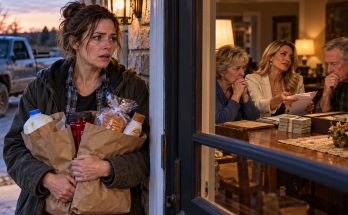
My father's words remained the clearest part of the conversation I had overheard.
He wanted to know whether any previous money had been repaid.
I remembered standing outside the door when he asked.
The grocery bags had been cutting into my fingers.
Ranata had answered him as though my inability to repay was something everyone already understood.
And my mother had not challenged that answer.
I wondered how long they had believed it.
Months?
Years?
I had no way of knowing.
I thought about asking Mom that question in my next message.
But I stopped myself.
I wanted her answer without Ranata standing beside her.
I wanted Dad to speak without looking toward my sister.
Most of all, I wanted to hear what my parents remembered before anyone tried to explain it away.
That mattered.
Because the story I had overheard was not merely embarrassing.
It involved money.
Actual money my parents believed had reached me.
I could not afford to approach it like another disagreement about my farm.
I sat down and unfolded the paper containing my questions.
The fold had become soft from being opened and closed.
I read the first one.
How much money?
I had been so focused on the fact that I received nothing that I had almost forgotten how little I knew about what my parents had given.
The amount might be small.
It might be enormous.
I had no evidence either way.
Then I read the second question.
To whom?
I knew Ranata had been speaking as though she handled my financial problems.
But I did not know exactly how money had changed hands.
Had my parents handed it directly to her?
Had they sent it somewhere?
Had they believed she was passing it along?
Those were the answers I needed.
I was not going to assume details simply because I was angry.
My phone vibrated again.
Mom said she and Dad could talk.
She also asked whether I was all right.
I read that question several times.
Was I all right?
Physically, yes.
Financially, more than I had ever imagined.
But emotionally, I felt as though someone had opened a door inside my family and revealed a room I had never known existed.
I answered simply.
"I'm okay. I just need to understand something."
That was the truth.
Perhaps not the whole truth.
But enough.
Mom responded that we could speak privately.
I did not ask whether Ranata would be there.
I had already made that request clear.
If we were going to discuss money supposedly given to me, I wanted to begin with the people who believed they had provided it.
I set the phone aside.
For a few moments, I felt relieved.
Then the relief gave way to dread.
Now the conversation was no longer something I was merely imagining.
It was going to happen.
I would have to tell my parents that I had heard them discussing me.
I would have to admit I listened from outside the door.
I would have to explain why I turned around instead of entering.
And then I would have to say something that might change how they saw Ranata.
I was not looking forward to any of it.
There had been a time when I would have done almost anything to avoid a family disagreement.
I could tolerate being underestimated.
I could tolerate comments about my truck.
I could tolerate being treated as the daughter whose life was less comfortable.
But I could not tolerate being assigned a debt I had never borrowed.
That was the line.
I thought about what I would say first.
Not an accusation.
A question.
"Dad, do you believe you've given me money?"
I spoke it aloud.
The kitchen did not answer.
I tried another version.
"Have you been sending money to Ranata because you thought I needed it?"
That sounded closer to what mattered.
But it also assumed something I had not yet confirmed.
I crossed that sentence off my paper.
I wanted to be careful.
I wanted to know the truth, not guide my parents toward the answer I expected.
I imagined my father looking at me.
Perhaps he would be confused.
Perhaps he would ask why I wanted to know.
Perhaps he would tell me he had been helping for years.
Whatever he said, I needed to listen.
That would be difficult.
Because I already knew how much the conversation hurt.
And I knew how tempting it would be to interrupt.
I had never been especially patient when someone misunderstood practical matters.
On the farm, a wrong assumption could cost time and money.
I preferred correcting problems before they grew.
Yet in my family, I had done the opposite.
I had allowed assumptions to remain because challenging them felt uncomfortable.
That habit had not served me well.
I looked at the final question on my paper.
What did my parents believe about me?
That question frightened me more than the others.
Money could be counted.
Payments could be traced.
A debt could be established or disproved.
But how did I correct years of disappointment that might have been built on false information?
How did I persuade my father that I had not ignored an obligation if he had spent years believing I owed him something?
How did I explain to Mom that I had never been too proud to admit needing help because I had never needed the help Ranata described?
I did not know.
And for once, I accepted not knowing.
I would begin with facts.
The feelings could come afterward.
I looked across the kitchen.
The unopened coffee package sat beside the bread.
I remembered choosing it from the shelf.
I had thought about Mom's preferences.
I had not thought about my own financial records.
I had not expected to defend the choices I made over fifteen years.
It seemed absurd that an ordinary errand had brought me here.
But perhaps ordinary moments were when people revealed what they really believed.
My family had not been preparing a confrontation.
They thought I was absent.
They were simply discussing a familiar problem.
Me.
That was what made the conversation so difficult to dismiss.
I had heard them when nobody expected me to answer.
I had heard how naturally Ranata described my supposed dependence.
I had heard how easily my parents accepted her role.
I could no longer tell myself their opinions were harmless.
I folded the paper.
Then I put it beside the phone.
I did not need to prepare a speech about the sale.
I had already decided that.
Thirty-nine million dollars was not an answer to the question of where my parents' money had gone.
It was proof of something entirely different.
My work.
My choices.
My financial position.
Those facts mattered to me.
But I would not use them to distract from the problem.
I wanted my parents to understand that I had been responsible for myself even when they believed I was struggling.
I wanted them to know I had never asked Ranata to collect money.
And I wanted to discover why they had not asked me directly.
I stood up and walked toward the window.
Outside, the property looked familiar.
It was strange knowing the sale had changed my legal relationship to the land without changing what I saw.
The view was still there.
The memories were still there.
The habits were still there.
I had worked so long to become independent that I had almost forgotten how deeply I still wanted my parents' respect.
Not admiration.
Not praise.
Respect.
The belief that I could speak honestly about my own life.
The willingness to ask me a question before accepting someone else's answer.
I had thought those things were already part of our relationship.
Now I knew I needed to ask.
I returned to the table and picked up my keys.
The familiar weight settled in my palm.
The old pickup was still outside.
I had no intention of replacing it simply because I could afford to.
For fifteen years, it had served me well.
It had carried groceries.
Equipment.
Work clothes.
And sometimes the tired version of myself who had spent the day trying to solve one more problem.
Now it would carry me toward a conversation I had avoided for too long.
Before leaving the kitchen, I looked at the groceries again.
I considered taking the coffee and creamer with me.
Then I decided not to.
I did not want to walk into another conversation with my hands occupied.
I wanted to be able to sit down.
Look at my parents.
And ask them directly what they believed they had done for me.
I put the keys in my pocket.
The decision was made.
I would not confront Ranata first.
I would not announce the farm sale.
And I would not accuse my parents of something I had not yet allowed them to explain.
I would ask.
Then listen.
And this time, I would make certain my own name belonged to my own voice.
Source: thknews11.store
Click here to continue reading: PART 10: Sitting Across From My Parents Without My Sister Present, I Finally Asked the Question Their Conversation Had Left Me Afraid to Hear Answered
I Arrived at My Parents’ House Carrying Groceries, Never Imagining That a Conversation Behind Their Front Door Would Change Everything I Believed
Part 9 of 15