I used to believe I understood my place in my family.
I was the daughter who worked too much.
The one who drove an old truck.
The one who never seemed to have anything impressive to show for all those years of effort.
I thought I had accepted that.
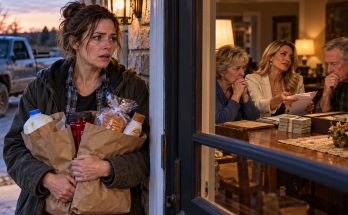
Then one Saturday afternoon, I stood outside my parents’ house with two grocery bags in my hands and heard something that made me question almost everything.
My older sister was inside.
She was talking about me.
And from the sound of it, she was telling my parents a story I had never heard before.
My name is Fay.
I was thirty-seven years old when it happened.
By then, I had spent fifteen years building a life that belonged to me.
It was not an easy life.
I had chosen work that required getting up early, staying out late, and learning how to fix things when paying someone else would have cost too much.
I lived on my farm.
I managed my property.
I kept track of expenses, repairs, and the endless little responsibilities that came with owning land.
Some days were exhausting.
Some years were harder than others.
But I had never considered myself helpless.
That distinction mattered to me.
It mattered more than I understood until that afternoon.
My family had always seen things differently.
At least, that was how it felt.
My sister, Ranata, had a comfortable home, a husband, and a newer vehicle.
Everything about her life seemed to fit the picture my parents had of success.
She looked settled.
She looked secure.
She looked like someone who had made the right decisions.
I looked like someone who still had a long way to go.
My pickup was old enough that people sometimes commented on it before saying hello.
My clothes often carried evidence of whatever work I had finished that morning.
I had never been especially interested in replacing things simply because they were getting old.
If something still worked, I used it.
If it stopped working, I tried to repair it.
If replacing it could wait, I waited.
That was not a sign of defeat.
It was how I had learned to manage what I owned.
But I had never made much effort to explain that to my parents.
Looking back, I can admit something.
I had grown comfortable letting them misunderstand me.
It was easier than arguing.
Easier than answering questions about my farm.
Easier than listening to Ranata compare my choices with hers.
Sometimes she made comments that sounded harmless until I thought about them afterward.
Sometimes she spoke about my work as though it were something I had been forced to settle for.
I rarely challenged her.
I had my reasons.
Or at least I thought I did.
I believed that explaining myself would only make me look defensive.
So I smiled when I needed to.
Changed the subject.
Went back to work.
I convinced myself that what my family thought about my life did not matter.
And for a long time, I believed that was true.
That Saturday began like an ordinary day.
My mother had asked me to bring a few things to the house.
Nothing expensive.
Nothing difficult.
Just groceries.
I had agreed without thinking much about it.
Picking up something for Mom was the kind of small favor I could do without rearranging my entire day.
There was no reason to make it complicated.
I stopped for the things she needed.
Milk.
Bread.
Coffee.
And the cinnamon-flavored creamer she liked.
I remember that creamer because it seemed so ordinary afterward.
It was one of those small things you recognize immediately on a grocery shelf.
I knew which one she preferred.
I knew she would notice if I brought the wrong kind.
There was something comforting about knowing such a simple detail about my mother.
At the time, I thought it meant our relationship was uncomplicated.
I knew what she liked in her coffee.
She knew I would bring it when she asked.
That seemed like enough.
I put the groceries in the passenger seat of my pickup.
Then I drove to my parents’ house.
I was not nervous.
I had no reason to be.
I knew the driveway.
I knew the front porch.
I knew the way the house looked during the afternoon.
I had walked toward that front door more times than I could count.
Nothing about the place suggested that this visit would be different.
Dad’s sedan was parked outside.
I pulled in beside it.
Then I noticed another vehicle.
Ranata’s SUV.
My older sister was already there.
I remember seeing it and thinking that I would probably have to listen to another conversation about her life.
That was all.
I did not wonder why she had arrived.
I did not wonder what she and our parents might be discussing.
I was bringing groceries.
I expected an ordinary family visit.
I turned off the engine.
The truck made its familiar little noises as it settled.
I sat there briefly, looking toward the house.
Then I reached across the seat for the bags.
The handles were thin plastic.
One bag held the milk.
The other held the bread, coffee, and creamer.
I took both.
Closed the door.
And walked toward the porch.
The groceries were heavier than they looked.
The handles pressed into my fingers.
I adjusted my grip as I approached the entrance.
I was close enough to the door to hear voices inside.
That was not unusual.
My parents did not always speak quietly when family was visiting.
I recognized Ranata first.
Her voice carried clearly.
I would have kept walking if I had not heard the particular seriousness in her tone.
She was explaining something.
Not chatting.
Not laughing.
Explaining.
I slowed without meaning to.
Then I heard her say that someone was refusing to admit how much trouble she was having.
I thought she was talking about another person.
Maybe someone she knew.
Maybe an acquaintance my parents had asked about.
I had no reason to assume the conversation concerned me.
Then she said my name.
Fay.
Just one word.
But I stopped.
My hand tightened around the grocery bag.
I remember looking toward the front window.
The blinds were closed.
Mom usually liked having them open during the day.
That small difference caught my attention.
I could hear voices.
I could not see anyone.
For a second, I considered knocking.
That was what I should have done.
I know that.
I was standing outside my parents’ home, listening to a private conversation.
I do not pretend that was admirable.
But hearing your own name changes the way you understand a conversation.
Especially when the people talking seem convinced you are not there.
Ranata said I had always been reluctant to admit when I needed assistance.
She made it sound like a familiar problem.
A weakness everyone had quietly accepted.
I frowned.
I knew how my sister talked about me.
She liked presenting herself as the sensible one.
The practical one.
The daughter who knew how things should be done.
I had heard enough little remarks over the years to recognize that version of her.
But this sounded different.
It was not a casual observation about my old pickup.
It was not a comment about the hours I worked.
She was describing a problem in my life.
A serious problem.
And she sounded certain about it.
I waited for one of my parents to question her.
Instead, I heard Mom say something too softly for me to understand.
Ranata answered.
She told them she had been taking care of things on my behalf.
I stared at the door.
Taking care of what?
My bills were mine.
My property was mine.
My decisions were mine.
There were obligations I had handled alone for years.
There were problems I had solved without asking anyone in my family for help.
I had never appointed my sister to manage anything for me.
I had never asked her to speak for me.
And yet, inside that house, she was speaking as though she had been carrying some burden that belonged to me.
I shifted the grocery bags.
The plastic scraped against my fingers.
I could feel the weight of the milk pulling down on one side.
I remember being annoyed at myself for standing there.
Part of me wanted to enter immediately and ask what she was talking about.
Another part wanted to hear enough to understand.
I had spent years avoiding arguments.
Now my name was being used in a conversation I knew nothing about.
I felt entitled to know why.
That was how I justified staying.
At first, I expected something small.
Maybe Ranata had exaggerated an old complaint.
Maybe she had misunderstood something about the farm.
Maybe she believed my truck needed replacing and had turned that into a story about my finances.
I could imagine her doing that.
It would have irritated me.
But it would not have surprised me.
I waited.
The voices inside moved through a brief silence.
Then my father spoke.
I recognized his tone immediately.
He was no longer making casual conversation.
He wanted a specific answer.
He asked Ranata how much assistance was required on this occasion.
I felt my shoulders stiffen.
On this occasion.
Those words stayed with me.
Not because they were dramatic.
Because they suggested there had been other occasions.
Other requests.
Other amounts.
I had not known about any of them.
I looked down at the groceries in my hands.
Milk.
Bread.
Coffee.
Cinnamon creamer.
I had come to deliver a few ordinary things.
And suddenly I was listening to my father discuss money I apparently needed.
I wanted to believe I had misunderstood him.
I really did.
There were explanations I could still imagine.
Perhaps they were discussing something unrelated and I had missed an important sentence.
Perhaps they were speaking about money in a general way.
Perhaps Ranata had only been offering advice.
But my father had asked a question that sounded very specific.
And he expected my sister to know the answer.
Not me.
Ranata.
That was the first moment I understood how little I knew about what my family had been saying when I was not around.
For fifteen years, I had worked to support myself.
I had made choices that did not always look impressive from the outside.
And I had assumed my family understood that I preferred to handle my own affairs.
Apparently, there was another story.
One in which I was struggling.
One in which Ranata had stepped forward.
One in which my parents were being asked to provide money.
I stood outside the door, trying to make sense of it.
And what frightened me was not that my parents might believe I needed help.
It was that they seemed to believe they had already been helping me.
Source: thknews11.store
Click here to continue reading: PART 2: My Father Asked One Question About the Money, and I Realized My Sister Had Been Describing a Life I Had Never Lived
I Arrived at My Parents’ House Carrying Groceries, Never Imagining That a Conversation Behind Their Front Door Would Change Everything I Believed
Part 1 of 15