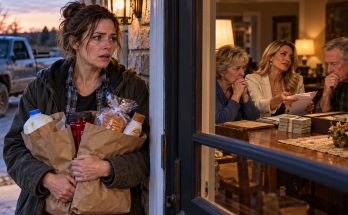
When I sat down across from my parents, I noticed how ordinary everything looked.
That bothered me.
I had spent days thinking about this conversation.
I had imagined anger.
Embarrassment.
Confusion.
But the room was familiar.
The furniture was where I expected it to be.
My parents looked like the same people I had known my entire life.
There was nothing in the room to suggest that they believed I owed them money.
I had expected to feel prepared.
Instead, I felt like the daughter who had arrived with groceries and forgotten how to knock.
Mom looked at me carefully.
"Are you sure everything's okay?"
I nodded.
"Nothing's happened to me. I just need to ask you something."
Dad waited.
He had always preferred getting to the point.
Usually, I appreciated that.
This time, I was grateful he did not rush me.
I placed my hands together.
There were faint marks where the grocery handles had pressed into my fingers on Saturday.
They were almost gone.
I found myself looking at them anyway.
Then I raised my eyes.
"I came here with groceries on Saturday."
Mom frowned.
"You did?"
"Yes."
"I didn't know you came."
"I know."
She looked toward Dad.
I kept speaking before either of them could ask more.
"I got to the porch. I heard you talking."
The room went quiet.
I hated admitting that.
I knew it sounded as though I had deliberately listened to a private conversation.
In a way, I had.
I could have knocked.
I could have walked away immediately.
Instead, I stayed because I heard my name.
I did not try to make that choice sound better.
"I heard Ranata talking about me."
Mom's expression changed.
Dad leaned back slightly.
Neither spoke.
I continued.
"She said I was having financial problems. She said she'd been handling things for me."
I waited.
Mom looked down.
Dad kept watching me.
That silence told me the conversation was familiar.
But it did not tell me what they believed.
So I asked.
"Dad, have you given money because you thought I needed it?"
He did not answer immediately.
I could feel my heartbeat in my hands.
Then he said yes.
Just one word.
I had known that answer was likely.
I had heard enough on Saturday to expect it.
Still, hearing him say it directly hurt.
I looked at Mom.
She nodded.
They believed they had helped me.
They believed there had been a real need.
And until that moment, neither had known I was unaware of it.
I swallowed.
"How much?"
Dad looked uncomfortable.
He asked why I wanted to know.
I could have become angry.
I almost did.
But I reminded myself why I had come.
"I need to understand what you think happened."
He studied me.
Then he asked whether Ranata had told me something.
"No."
That answer was simple.
"Ranata hasn't told me anything. That's the problem."
Mom's hands rested in her lap.
I could see she was beginning to understand that this was not an ordinary disagreement between sisters.
I took a breath.
"I've never asked Ranata to handle my bills."
Dad frowned.
I continued before he could respond.
"I've never asked her to get money from you for me."
Mom looked up sharply.
"What?"
"I didn't know you were giving anyone money on my behalf."
The words sounded strange in the room.
Almost impossible.
But they were true.
Dad leaned forward.
He asked whether I was saying I had not received the assistance.
I looked directly at him.
"That's exactly what I'm saying."
There was a long silence.
I did not fill it.
For years, I had often allowed Ranata to explain things because I disliked conflict.
Now I needed my parents to understand my own words.
I had not borrowed money.
I had not accepted payments through my sister.
I had not authorized any arrangement.
Those were not opinions.
They were facts.
Mom asked whether I was certain.
That question hurt.
I tried not to let it show.
"Mom, I would know if someone had been giving me money."
She pressed her lips together.
I could see she was upset.
I did not want to humiliate her.
I did not want her to feel foolish for trusting her daughter.
But I could not soften the truth until it became meaningless.
Dad looked toward the floor.
He seemed to be considering something.
I waited.
Eventually, he asked why I had never told them I was doing better.
I felt frustration rise.
That question was exactly what I had feared.
It shifted the conversation toward my finances.
Toward whether I was successful enough to need help.
I shook my head.
"This isn't about whether I've had difficult years."
I kept my voice steady.
"It's about money I never received."
Dad looked at me.
I continued.
"I've had expenses. I've had repairs. I've had plenty of difficult days. But I handled them."
Mom listened.
"I never asked Ranata to speak for me."
I paused.
"And I never asked either of you for a loan."
That was the statement I needed them to hear.
Not that I had become wealthy.
Not that I was more successful than they realized.
Only that the debt they believed existed had never been mine.
Dad asked whether I was suggesting Ranata had lied.
I looked at him for a moment.
I did not want to answer too quickly.
"I know what she said about me wasn't true."
That was as far as I could honestly go.
"I don't know exactly what she told you. That's why I'm asking."
Mom looked distressed.
I could understand why.
She had believed she was helping one daughter through another.
Now I was telling her that the arrangement had never reached the person it was supposed to help.
There was no comfortable explanation for that.
I did not accuse my parents of deliberately excluding me.
I asked instead why they had not spoken to me directly.
Mom seemed uncertain how to answer.
She said Ranata had made it sound as though I was embarrassed.
I closed my eyes briefly.
That word again.
Embarrassed.
Too proud.
Unwilling to admit trouble.
It was the same description I had overheard on Saturday.
I opened my eyes.
"Being private doesn't mean I can't answer a question."
Dad nodded slowly.
I did not know whether he agreed or simply understood what I was saying.
I continued.
"If you thought I needed money, you could have called me."
Neither answered.
"You could have asked whether I was struggling."
I looked from one parent to the other.
"You could have asked whether Ranata was helping me."
Mom looked down.
"I would have told you the truth."
There was no need to raise my voice.
The truth was painful enough.
I had spent fifteen years being careful with money.
I had made decisions my family did not always understand.
I had kept my financial affairs private because I did not want every choice debated.
But I had never hidden a request for help.
There had been no request.
That distinction seemed to be settling in the room.
Dad asked whether I had been having problems with the farm.
I almost laughed.
Not because the question was funny.
Because it showed how deeply the old story had shaped his understanding.
"I've had ordinary business problems."
I chose my words carefully.
"That doesn't mean I needed Ranata to rescue me."
He looked at me without speaking.
I realized he had probably believed every hard season was evidence that I was falling behind.
Every repair.
Every delayed purchase.
Every year I kept the old truck.
Perhaps none of those things had meant what he thought.
I wanted to explain that.
But I did not want to turn the conversation into a defense of my entire life.
So I returned to the money.
"Did you give it to her directly?"
Dad hesitated.
Then he acknowledged that Ranata had been involved in arranging the help.
I asked whether he had ever confirmed that I received it.
He did not answer right away.
Mom looked at him.
Then at me.
I understood the silence.
They had trusted the arrangement.
They had trusted Ranata.
And they had not verified that the money reached me.
I felt something tighten in my chest.
I had expected that possibility.
Hearing it confirmed through their hesitation was still difficult.
I asked whether they had kept records.
Dad said there were records of the money they had provided.
That was important.
For the first time, there was something concrete we could examine.
Not an impression.
Not a family opinion.
Records.
I asked whether he would show them to me.
He looked surprised.
I understood why.
From his perspective, the money had been a private matter between him, Mom, and Ranata.
Now I was asking to see financial details.
But my name had been used as the reason.
And I needed to know what had happened.
I explained that.
"I don't want to argue about what anyone intended."
My voice was quiet.
"I want to know where the money went."
Mom nodded.
Dad remained thoughtful.
I could see this was harder for them than they had expected.
They had begun the conversation believing they were helping me.
Now they were being asked to consider whether they had been misled.
I did not enjoy seeing them upset.
Despite everything, they were still my parents.
I remembered Mom asking for groceries.
I remembered Dad's sedan in the driveway.
I remembered the familiar house.
These were people I loved.
But love did not make the unanswered questions disappear.
I asked how long they had believed I needed assistance.
Neither gave me a simple answer.
That made sense.
The belief had apparently developed over time.
There may not have been one conversation that started everything.
Ranata had made comments.
My parents had drawn conclusions.
And eventually, financial help had become part of the story.
I could see how that might happen.
But understanding how something happened did not make it acceptable.
I told them that plainly.
"I know you thought you were helping."
Mom looked at me.
"But I need you to understand that I never received the help."
Dad rubbed his forehead.
I waited.
Then I added something I had not planned to say.
"I wish you'd trusted me enough to ask."
My voice sounded different on that sentence.
Not angry.
Tired.
Mom's eyes filled.
I looked away.
I did not want tears to become another reason to stop the conversation.
There were still questions.
Important ones.
I asked whether they had ever spoken to me about repayment.
Dad shook his head.
That answer mattered.
He had believed I owed money, but he had not asked me to repay it directly.
He had relied on Ranata to explain why nothing had been returned.
I thought about Saturday.
His question had sounded familiar.
Now I understood why.
He had been asking my sister about a debt he thought belonged to me.
He had never asked me.
The pattern was painfully clear.
Ranata described the problem.
My parents provided help.
Ranata explained the lack of repayment.
And I continued living my life without knowing any of it was happening.
I did not know whether she had kept the money.
I still needed evidence.
But I knew the story about my need for assistance was false.
And I knew my parents had acted on it.
I asked them not to provide any more money in my name until we understood what had happened.
Dad agreed.
Mom nodded.
It was a small decision.
But it mattered.
For the first time, my parents were making a decision about my supposed financial needs while I was actually present.
I looked at them.
I wanted to say more.
I wanted to tell them about the sale.
I wanted to explain how badly they had misunderstood my life.
But I stopped.
The thirty-nine million dollars could wait.
This conversation was not about proving I was successful.
It was about finding out what had happened to money they believed was helping me.
I left that question in front of us.
And for once, nobody looked toward Ranata for the answer.
Source: thknews11.store
Click here to continue reading: PART 11: My Parents Had Trusted My Sister to Explain Every Missing Payment, but I Needed Them to See the Difference Between Concern and Proof
I Arrived at My Parents’ House Carrying Groceries, Never Imagining That a Conversation Behind Their Front Door Would Change Everything I Believed
Part 10 of 15