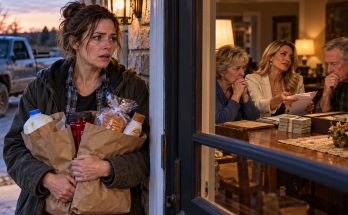
I had expected the money from the farm sale to bring a sense of relief.
In some ways, it had.
The transaction was complete.
The paperwork was being finalized for my records.
I no longer had to make every future decision around the needs of the property.
But I had not expected to feel this unsettled.
I had spent years working toward independence.
Now I had it in a form most people would immediately recognize.
And still, I could not stop thinking about the way my parents had talked about me.
It was a strange feeling.
I could look at the money in my account and know I had accomplished something significant.
But I could not look at my family and know whether they believed I was honest.
That was what troubled me.
The amount of money was almost irrelevant to the question.
Even if the sale had never happened, I would still have had the right to be believed.
I would still have had the right to know whether someone was collecting money in my name.
I would still have had the right to correct the story being told about me.
Yet I kept finding myself drawn toward the thirty-nine-million-dollar figure.
It was proof.
That was how part of me wanted to use it.
I could show my parents the closing documents.
I could let them see that I had sold the farm successfully.
I could tell them I was not struggling.
It would be simple.
And it would probably change their assumptions.
But the more I thought about doing that, the more uncomfortable I became.
I did not want the truth to depend on the size of my fortune.
I had been honest before the sale.
I had been independent before the sale.
I had been responsible for my own expenses before the sale.
Those things did not suddenly become true three days earlier.
They had been true for years.
If my parents only believed me after learning about the money, what would that say about how they had seen me before?
I did not like the answer.
I sat at the kitchen table with the papers from my accountant nearby.
There were documents I needed to keep.
Records that mattered.
For fifteen years, I had saved papers connected to the farm because I knew how quickly a small detail could become important.
An invoice.
A receipt.
A signed agreement.
A repair record.
I had learned not to rely entirely on memory.
Now I was facing a family problem in which almost everything I knew came from a conversation overheard through a door.
I wanted records.
I wanted amounts.
I wanted to see what had actually happened.
But I had none of that yet.
I had only the questions on my paper.
And the memory of my father's voice.
I kept returning to the way he had asked about repayment.
There was disappointment in the question.
At least, that was how I remembered it.
I could have been wrong.
I had been upset.
I had heard the conversation from outside.
But he had sounded like a man who believed he had been patient.
That hurt me.
I had never wanted my father to think I took advantage of him.
I had never asked him to cover an expense.
I had never treated our relationship as a source of money.
I did not want anything from him that I could provide for myself.
That was not because I did not love him.
It was because I valued being able to stand on my own.
I thought my parents understood that.
Apparently, they did not.
I looked toward the kitchen counter.
The coffee I had bought for Mom was still there.
It had become an irritating reminder of how ordinary the visit was supposed to be.
I had not gone to my parents' house to discuss an inheritance.
I had not gone to ask for financial support.
I had gone because Mom wanted milk, bread, coffee, and creamer.
If I had arrived a few minutes earlier or later, perhaps I would never have heard the conversation.
I might have walked inside with the bags.
Ranata might have changed the subject.
Dad might have said hello.
Mom might have thanked me for remembering the creamer.
And I would have left believing nothing important had happened.
That possibility bothered me.
Not because I wished I had missed the conversation.
But because it showed how easily the false story could have continued without my knowledge.
I had been close enough to hear my name.
That was all that separated ignorance from understanding.
A few steps.
A closed door.
A conversation that was not meant for me.
I wondered how many times I had visited while my parents believed I needed money.
I wondered whether they had watched me and looked for signs of hardship.
I wondered whether they had discussed my old truck after I left.
Those thoughts were painful.
But they were still guesses.
I reminded myself of that.
I could not accuse my parents of every imagined judgment.
I could only ask them what they actually knew.
That was important because I did not want to become like the person I feared Ranata had been.
I did not want to create a story out of assumptions.
I wanted to understand the truth.
I thought about my sister's life.
Her comfortable house.
Her husband.
Her newer SUV.
From the outside, she seemed to have the kind of life my parents admired.
I had not resented her for having those things.
I had wanted different things.
Or at least I had been willing to accept different sacrifices.
My farm required work.
It demanded time.
There were expenses I chose to delay.
There were comforts I could have bought but did not consider necessary.
I had never seen that as a competition.
Ranata seemed to see it differently.
She had often treated my choices as evidence that I had not achieved enough.
I had let her.
That was something I could no longer deny.
I had allowed her remarks to pass because I believed correcting them would accomplish nothing.
But I had not understood that those remarks might influence what my parents believed.
I thought again about the way she spoke on Saturday.
Calm.
Certain.
As though she were reporting facts.
She had not sounded concerned about whether I would disagree.
Perhaps she believed I would never hear the conversation.
Perhaps she believed I would never challenge her.
I could not know.
But I understood why she might have expected my silence.
I had been silent for years.
The realization made me uncomfortable.
I had always thought of myself as someone who could handle difficult situations.
On the farm, I did not have the luxury of avoiding problems because they were unpleasant.
If something broke, I dealt with it.
If an expense arrived, I found a way to manage it.
If a decision needed to be made, I made it.
Yet when my sister made an unfair remark, I usually said nothing.
I told myself that was maturity.
Sometimes it probably was.
Not every slight deserved a response.
But there were limits.
I had not recognized them soon enough.
I could not change that now.
I could only decide what I would do next.
The message I had sent Mom remained on my phone.
I looked at it more often than I wanted to admit.
I had asked to speak with her and Dad privately.
That was all.
I did not want to pressure her with a long explanation before we met.
I did not want Ranata involved.
I wanted my parents to have the chance to tell me their understanding without anyone prompting them.
That seemed fair.
It was also difficult.
Because part of me wanted immediate answers.
I wanted to know whether there had been one payment or many.
I wanted to know whether the money had come from savings.
I wanted to know whether my parents had made sacrifices because they believed I needed help.
The possibility that they had done so troubled me.
I could handle the embarrassment of being underestimated.
I could handle hearing that Ranata thought my farm was unsuccessful.
But the idea that my parents might have given away money under a false impression was different.
That involved their trust.
Their finances.
Their decisions.
And perhaps their expectations of me.
I could not ignore it.
I thought of Mom's question.
Did I really need more help?
She had sounded hesitant.
I had heard that clearly.
It suggested she was worried about continuing.
Perhaps she had begun to doubt Ranata's account.
Or perhaps she simply wanted to understand why the problem never seemed to improve.
I did not know.
But I wanted to ask her.
I wanted to know why she had not called me herself.
I wanted to know what prevented such a simple conversation.
The more I thought about it, the more I realized that the money was only one part of the problem.
The other part was the way decisions about me had been made without me.
My family had apparently discussed my circumstances.
Reached conclusions.
Provided assistance.
Expected repayment.
And continued discussing whether more money was necessary.
All without asking the person whose name was being used.
I had been thirty-seven years old when I overheard it.
Not seventeen.
Not someone who needed a parent to manage daily responsibilities.
I owned property.
I handled my own finances.
I had spent fifteen years building a business and making difficult decisions.
Yet I had been treated as though I could not explain my own situation.
That was the injury I kept feeling.
Not simply that my sister might have lied.
But that my parents had accepted someone else as the authority on my life.
I did not know how to say that without sounding bitter.
I practiced several sentences.
None seemed quite right.
I considered saying I was disappointed.
That sounded too mild.
I considered saying I was angry.
That was true, but incomplete.
I considered asking whether they trusted me.
That sounded like a question designed to make them feel guilty.
I wanted to avoid that.
I wanted answers, not a performance.
So I returned to the simplest possible approach.
I would ask what money they believed they had given me.
Then I would listen.
I would not interrupt immediately.
I would let them explain.
Afterward, I would tell them plainly that I had never received it.
No elaborate speech.
No announcement about the sale.
Just the truth.
The thought steadied me.
I had spent the last day imagining every possible reaction.
Dad might be angry.
Mom might be embarrassed.
Ranata might deny everything.
Those possibilities were real enough.
But I could not control them.
I could control what I said.
I could control whether I remained honest.
And I could refuse to accept an obligation I had never agreed to.
That was enough for now.
I stood up and gathered the documents from my accountant.
I placed them together where they belonged.
The sale was complete.
That part of my life had already changed.
I did not need to prove it to my family that day.
I looked at the paper containing my questions.
Then I folded it once.
I knew what I wanted to ask.
I did not need to keep reading it.
I placed it beside my phone.
The afternoon had passed quietly.
I had not confronted anyone.
I had not told my parents about the sale.
I had not spoken to Ranata.
But I had begun to understand what I needed from the conversation ahead.
I did not need admiration.
I did not need congratulations.
I did not even need my family to agree that my choices had been wise.
I needed them to understand that I had not borrowed their money.
And that someone had been speaking in my name without my permission.
Whatever they believed about my old truck or my work clothes was secondary.
Whatever they thought about the success of my farm was secondary.
The truth about the money came first.
For fifteen years, I had allowed my sister to describe my life however she wanted.
I could no longer do that.
Not when her words had become financial claims.
Not when my parents believed I owed them repayment.
Not when their trust might have been used against them.
I had spent years learning how to protect the property I owned.
Now I needed to protect something less visible.
My right to tell the truth about my own life.
Source: thknews11.store
Click here to continue reading: PART 8: I Finally Understood That Revealing My Farm Sale Would Not Answer the Question of Who Had Been Taking Money in My Name
I Arrived at My Parents’ House Carrying Groceries, Never Imagining That a Conversation Behind Their Front Door Would Change Everything I Believed
Part 7 of 15